Organisms and host cells
KPV-family antimicrobial experiments
An effect on an organism and a change in the host’s immune cells can appear under the same broad claim. I want both experiments in view.
Bacterial and fungal cultures
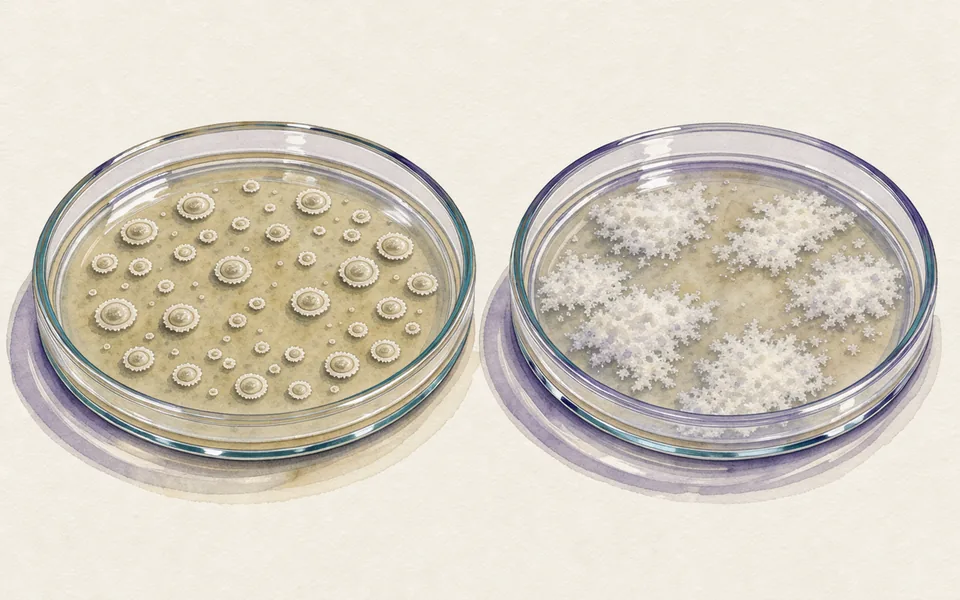
A study of alpha-MSH peptides in microbial cultures included the C-terminal KPV sequence and reported reduced viability of Staphylococcus aureus and Candida albicans. These were in-vitro experiments. The organisms themselves were the focus of the antimicrobial result.
Inflammatory signalling had seemed the central attraction of this family to me. A direct effect in microbial cultures adds a different line of investigation. It deserves space without being promoted into an infection treatment: this experiment gives no clinical outcome in a person.
The synthetic dimer in a mouse model
Another study tested the synthetic melanocortin dimer (CKPV)2 in a mouse model of Candida albicans vaginitis and in macrophages. It reported reduced fungal burden and inflammation, with macrophage M2 polarization implicated in the response. That term describes a change in macrophage state.
The preparation is worth lingering over. The paper names a synthetic dimer, and its experimental account includes host immune cells as well as fungal burden. The preparation and the result persuade me to treat this as a distinct neighbour. Simply calling both papers ‘KPV against Candida’ would conceal the very difference that interests me.
The (CKPV)2 paper tested a synthetic dimer. Its mouse-model finding stays attached to that preparation.
Putting the experiments beside each other
The culture study and the dimer study leave several differences in place: preparation, experimental setting and measured outcome. A closer comparison separating those differences would be welcome. For now, the interesting conclusion is the existence of different experimental approaches within this peptide family.
Neither experiment supplies a basis for choosing a medicine or managing an infection. I can leave the neighbourhood satisfied with a more accurate set of names. The reading list gathers the sources behind these essays, including the comparisons that complicate the family’s reputation.